

Setting Long-Term and Short-Term Goals: A Clear Way To Plan Your Future
If you are reading this, chances are you are looking for a clear, realistic way to set long-term and short-term goals that actually support you in life, not just your to-do list. You want clarity. You want momentum. You want goals that actually move your life forward with intention.
That is exactly what this guide is here to do.
We believe at The Head Plan, that the day you begin writing your goals is the first day of the rest of your best life!
Whether you are brand new to goal setting or you have been writing goals for years, we will walk you through how to set long-term and short-term goals, The Head Plan way. With The Head Plan Journal, you’ll not only become a goal-setter, but more importantly a goal-achiever!
Why goal setting still matters in 2026
There is a lot of noise around productivity right now. Faster, better, optimise everything. But here is the truth most people miss. Goals are not about doing more. They are about doing what actually matters to you.
Setting goals has the ability to change your life. But don’t just take our word for it. A Harvard Business Study found that people who set goals are more likely to succeed and feel more satisfied in their lives than those who don’t.
When you set a new goal, two very exciting things happen:
One, you get clarity on what it is that you want, which in turn makes you more likely to actually get what you want.
And two, you activate the part of the brain responsible for sorting and filtering.
This part of the brain is known as the Reticular Activating System. When you know what you are working towards, your brain starts filtering information differently. You notice opportunities. You make better decisions, making the attainment of your goal much easier.
This is exactly why goal setting is the foundation of The Head Plan Journal. Not rigid planning. Not pressure. Just intentional direction.
How to set long-term and short-term goals
Before we break this down step by step, it helps to understand the difference between long-term goals and short-term goals.
Long-term goals
Think of these as your vision for the future. These describe the direction you want your life to move in over the next five to ten years.
Short-term goals
Once you’re happy with your long-term goals you break them down. These are the actions and milestones that help you get there.
Both matter. And when they work together, goal setting becomes far less overwhelming and far more effective.
Step one: zoom out before you zoom in
One of the biggest mistakes people make with goal setting is starting too small. You end up with a to-do list, not a vision.
Before you think about weekly actions, really take the time to envision how you want your life to be.
Ask yourself:
What do I want my life to feel like in five to ten years?
Don’t hold back here, you deserve the life you want…
Step two: divide your goals into life areas
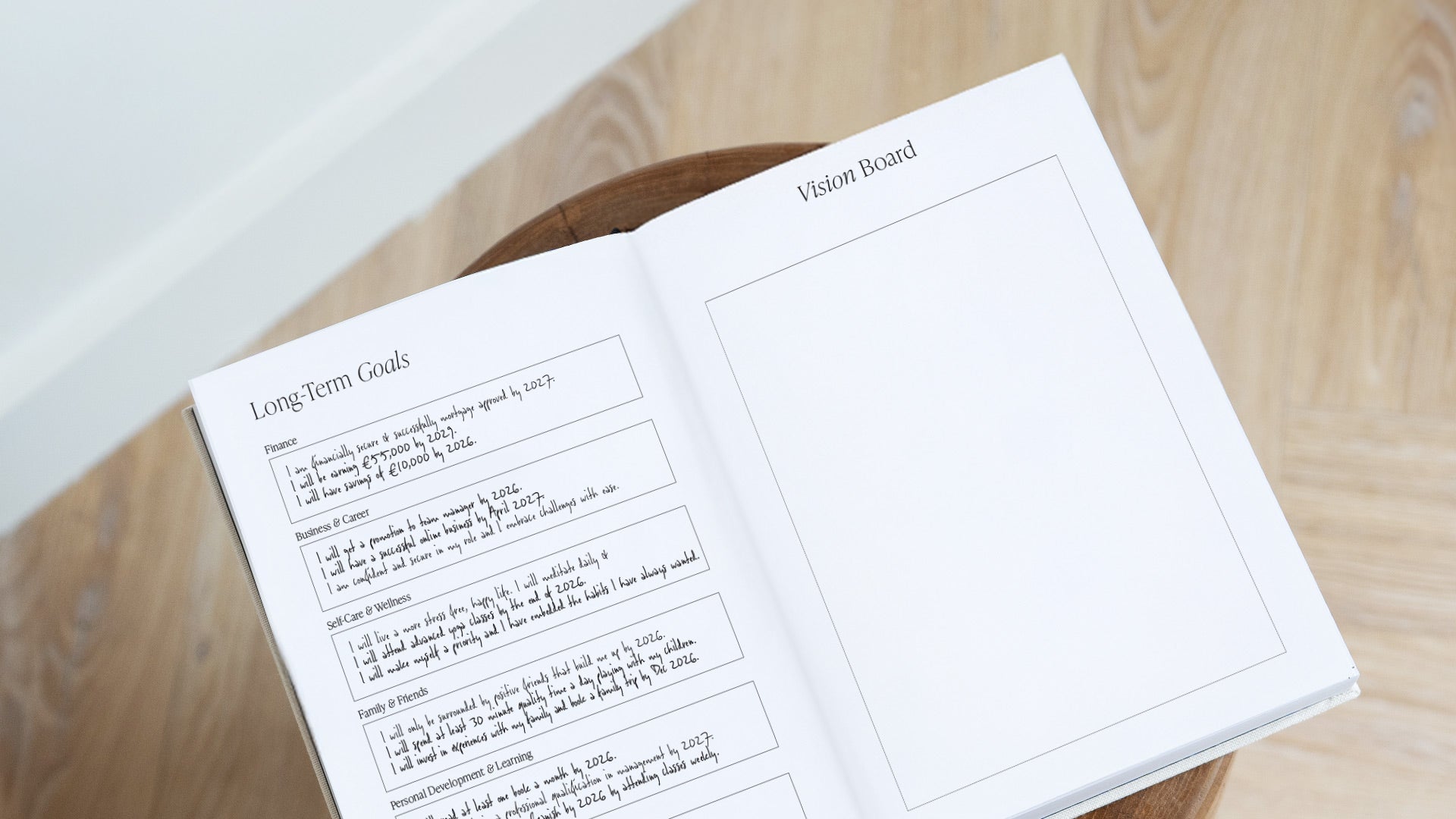
Thinking about your whole life at once can feel overwhelming. That is why we break goals into six goal-setting areas in The Head Plan Journal. This helps you create balance and avoid focusing on just one part of your life.
Finance
This is not just about numbers. It is about your relationship with money.
Ask yourself:
What would feeling confident with money look like for me?
This could be hitting a certain savings goal, clearing your overdraft, feeling calm checking your bank account, or planning for your future self.
Business & career
This section is all about purpose and progress.
Think about the kind of workday you want. The environment. The energy. The impact.
Maybe you want to break free from the 9-5 to launch your own business or maybe it’s hustling for a new promotion. If so good for you! Consider the characteristics of your dream job and write it all down!
Self-care & wellness
Goals here support your capacity to show up everywhere else.
This might look like better boundaries, reducing stress, making more time for yourself, movement that feels good, or daily practices that support your mental health.
Family and friends
Relationships shape our quality of life.
Ask yourself :
If all of the relationships in your life were functioning perfectly what would they look like? Who do you want to spend more time with and what would you be doing?
Personal development and learning
This section is about growth that comes from within and becoming the version of you.
The relationship you have with yourself is the most important one, which is why personal development is an ongoing investment. Whether it’s reading more, building confidence, managing your inner critic, or learning new skills, each step helps you grow and evolve.
Physical environment
Your surroundings affect your focus and mood more than you think.
This could be improving your workspace, decluttering your home, or creating an environment that supports the life you want.
Ask yourself:
How does your environment really make you feel?
Step three: turn long-term goals into short-term goals
Once your long-term goals are clear, it is time to make them actionable.
Think of these like your staircase in achieving your long-term goals.
For example:
Long-term goal: Feel confident and energised in your daily life.
Short-term goals might include:
- Start a 10 minute morning movement
- Schedule a self-care activity each week (Pilates, meditation, journaling)
- Identify three habits that drain your energy and gradually reduce them
Step four: write it down & make it happen
Did you know only 3% of people actually write their goals down?
Writing your goals down is not just a nice idea. It changes how your brain engages with them.
When you put pen to paper, you are signalling that this matters.
In The Head Plan Journal, we encourage you to review the goals you’ve set every day so your mind stays focused on your priorities and keeps attracting everything you need to achieve.
A simple daily check-in is enough:
What is one small action I can take today that supports my goals?
Small, consistent steps add up faster than bursts of motivation.
Step five: use visual cues to stay connected
This is where The Head Plan Journal really shines
To support your long-term goals use your Vision Board space in your Head Plan Journal to visualise the life you want to create.
Vision boards are powerful because they keep your goals visible. Pin images, quotes or words that represent the confidence, energy and calm you’re aiming for. This will serve as your daily reminder or your long-term goals and helps guide your short-term actions.
Remember, clarity fuels motivation. The more specific your goals are, the easier they are to follow through on.
Step six: let it happen
This is the part people often forget.
Goals work best when paired with trust.
You show up. You take small daily actions. You review and adjust when needed. And you let go of the need to control every outcome.
Progress does not always look linear. That does not mean it is not happening.
As goal getter and motivational author, Gabby Bernstein puts it ”let go of the need to control and allow the universe to do her thing”
Bringing it all together: goal setting that works in real life
Setting long-term and short-term goals is not about fixing yourself. It is about supporting the version of you that already wants more clarity and intention.
If you already have The Head Plan Journal, use this guide to revisit your goal pages with fresh eyes. You might be surprised by how much shifts when you give yourself permission to dream a little bigger and plan a little kinder.
Your goals do not need to be perfect. They just need to be yours.
Ready to reconnect with what you are working towards? Open your journal, turn to your goal-setting pages, and begin again.